
Lycoming County Criminal History Checks
Begin with the record that answers the actual question. The free Unified Judicial System of Pennsylvania Web Portal Case Search is the best first stop for a filed Lycoming County case. A police report remains with the arresting agency. A county custody record may sit with Central Processing or the Prison. PATCH supplies a statewide Pennsylvania State Police response, not the full file from any one of those offices.
Good identifiers reduce false matches. Keep the full name, spelling variants, date of birth, filing range, arresting agency, docket number, OTN, complaint number, or incident number when known. A portal result is a lead until its identifiers and disposition match the person and event being researched.
- Choose UJS for a case, the arresting agency for its report, or PATCH for a statewide Pennsylvania history.
- Enter the strongest identifiers available and select Lycoming County or the correct court office.
- Compare the filing date, court, OTN, agency, and case status before treating a result as a match.
- Open the public docket, then ask the Clerk or correct Magisterial District Judge for any available underlying paper file.
- Use the official custodian when a certified copy, correction, or formal statewide response is required.
Four Lycoming Arrest Records Compared
One Lycoming County arrest can produce several records because the county budget separates Central Processing, County Prison, Pre-Release, and the County DUI Center. Police first create an incident or arrest report. Processing and confinement offices then create intake and custody data. A Magisterial District Judge opens the first court record, and a Common Pleas docket follows when charges are held for court. Pennsylvania State Police later compiles reportable arrest and disposition data at the Central Repository.
| Record | Custodian | Best use | Main limit |
|---|---|---|---|
| Incident report | Arresting police agency | What officers documented | Protected parts may be redacted |
| Booking or custody record | County processing or prison | Intake and custody status | Not a finding of guilt |
| Court docket | MDJ or Clerk of Courts | Filed charges and outcomes | Recent entries can lag |
| PATCH response | PSP Central Repository | Statewide Pennsylvania history | Not a federal or local narrative |
The county budget shows these separate operations. That local structure explains why no single search returns the whole criminal record.

The organizational record helps a reader direct each request to the office that created the information.
Note: Charges recorded at booking may change before the District Attorney files a criminal information in Common Pleas.
Official Background Checks in Pennsylvania
The Pennsylvania State Police Central Repository runs Pennsylvania Access To Criminal History, known as PATCH. A standard name check costs $22, and notarization adds $5. An online user may submit up to ten checks in one session and pay by major card. A standard mailed request uses Form SP 4-164 with a certified check or money order. For self-review, Form SP 4-170 is mail only, costs $20, and cannot be notarized.
PATCH statuses have narrow meanings. “Request Under Review” means manual review, not that a record was found. Review may take two to four weeks. “No Items Found” often points to a mismatch in the control number, request date, or requester name used in the status search. PATCH checks Pennsylvania law-enforcement history and does not include federal history.
The official PATCH portal shows the State Police repository entry point.
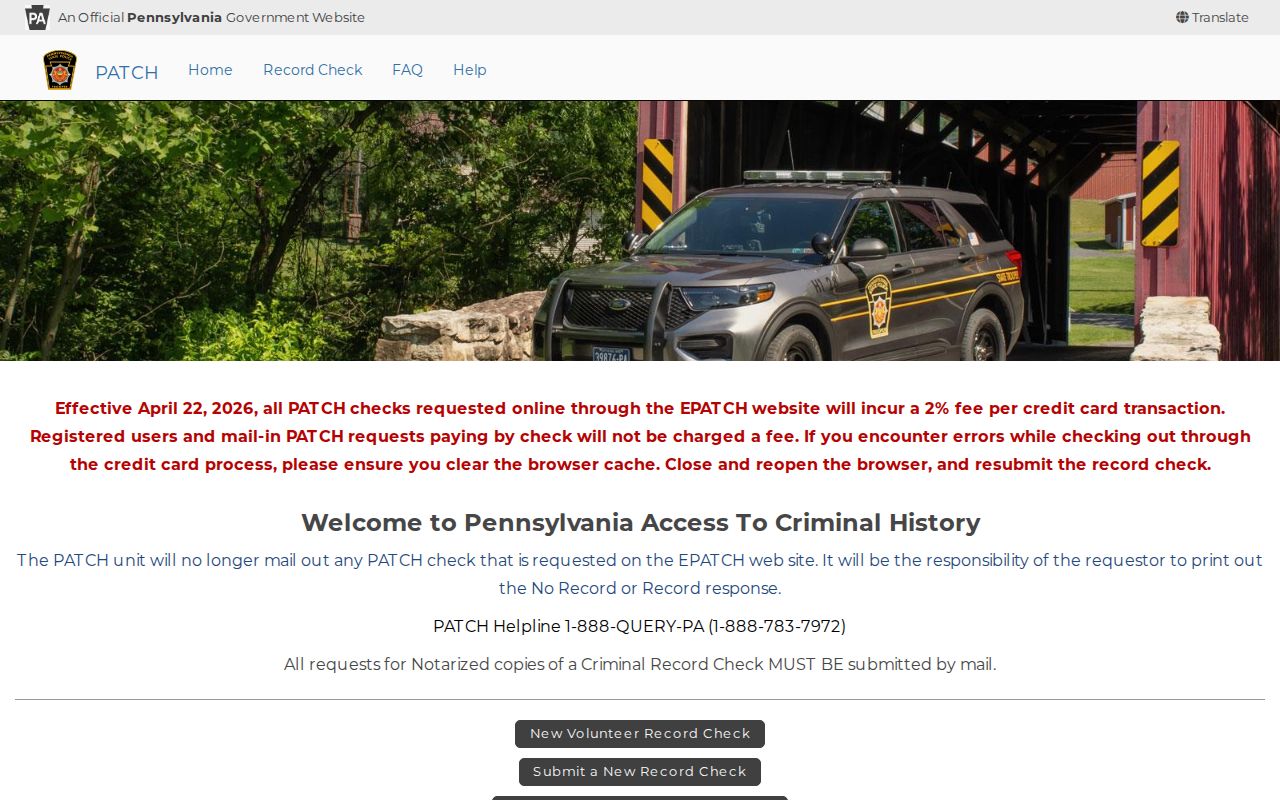
This statewide response should be read beside, not in place of, the underlying Lycoming County court docket.
Note: A PATCH “Under Review” status describes processing and does not establish that Pennsylvania State Police found a record.
Fingerprint Records Beyond Lycoming
Pennsylvania uses IDEMIA/IdentoGO for fingerprint capture under programs that require a statutory fingerprint result. A person must preregister with the correct service code, bring acceptable identification, and pay at the service site unless an authorization code applies. Walk-ins may wait. The Pennsylvania Department of Human Services states that results are mailed and take at least seven to ten business days.
That fingerprint channel differs from both PATCH and UJS. PATCH is a Pennsylvania name-based repository product. UJS displays court dockets. A federal Identity History Summary uses an FBI fingerprint channel. Someone reviewing their own record should confirm which product the requesting authority actually requires before paying or scheduling an appointment.
The official Pennsylvania fingerprint instructions set out preregistration and identification steps.
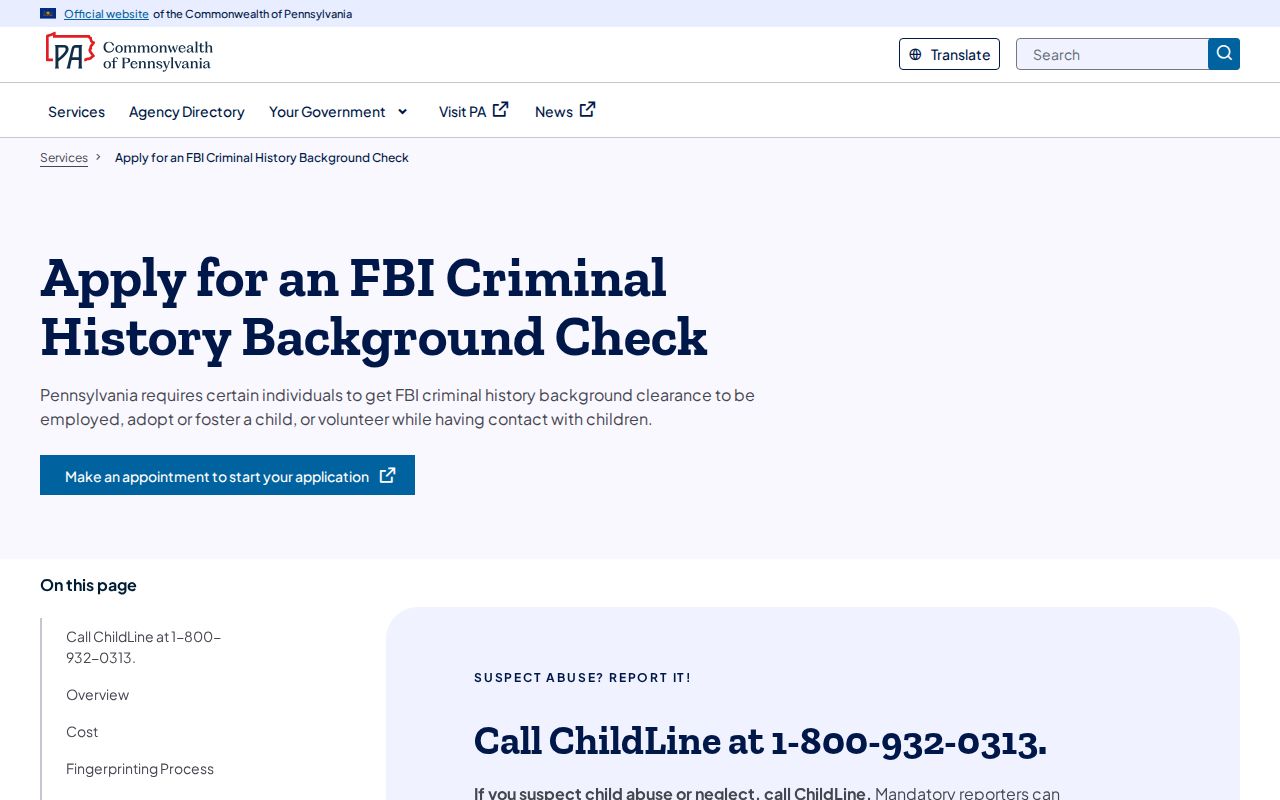
The correct service code matters because different statutory programs route and price results differently.
Kinds of Criminal Records
Lycoming County criminal records are defined by who creates them and when. A Williamsport, borough, college, or State Police agency may retain the incident narrative. The county keeps processing or custody information. Six Magisterial District Courts handle preliminary stages and summary matters. The Clerk of Courts maintains felony and misdemeanor files in the Court of Common Pleas, Pennsylvania's 29th Judicial District.
Other sources answer narrower questions. A court issues a warrant. Adult Probation holds county supervision material, while state parole is separate. The Pennsylvania Department of Corrections locator covers state custody or supervision, not a fresh Lycoming County booking. The PSP Megan's Law Website publishes a legally defined public-safety extract rather than a list of every sexual-offense case.
- Police record: the agency narrative, citations, and releasable incident details.
- Custody record: intake, commitment, housing, release, or transfer data held at the county level.
- Court record: complaints, filed charges, bail, events, disposition, sentence, and financial entries.
- Repository record: reportable Pennsylvania arrest and disposition history compiled by State Police.
- Restricted record: juvenile, expunged, sealed, or limited-access material removed from ordinary public view.
Lycoming Criminal Files at the Courthouse
Lycoming County Courthouse is at 48 West Third Street in Williamsport. The Prothonotary and Clerk of Courts public counter is on the first floor, with published hours of Monday through Friday, 8:30 a.m. to 5 p.m. Visitors enter through the Fourth Street security entrance. A portal search is often enough for a docket sheet, but it may not expose every underlying document or a restricted case.
The official county page confirms the courthouse location and county main number.

This building is the primary counter for Common Pleas criminal files, not a generic sheriff search site.
The county packet publishes the first-floor counter and office hours.

The counter fallback matters when the public docket links only to a docket sheet and not the requested filing.
The official courthouse entry guidance identifies Fourth Street screening.

Parking and transit benefits listed for jurors should not be assumed to apply to an ordinary records visit.
Lycoming County Criminal Records: What They Contain
A public Common Pleas docket identifies the case and tracks it from filing through final entries. Its fields can connect the police event, the originating MDJ case, and later court action. Yet a docket does not reproduce the whole police report, and a PATCH response does not provide the court's full event log. Read the record title before reading the result.
| Name and identifiers | Caption, docket number, OTN, complaint or incident number, county, and filing date. |
|---|---|
| Arrest and bail | Arresting agency, originating MDJ, bail type, amount, status, and changes when public. |
| Charges | Count, statute, description, grade, offense date, and a separate disposition for each charge. |
| Case events | Filings, hearings, continuances, pleas, trial activity, orders, and judicial officers. |
| Outcome | Dismissal, acquittal, conviction, sentence, probation, restitution, and appeal entries when applicable. |
| Financial data | Public assessments, payments, adjustments, and balance fields tied to the case. |
Public access omits Social Security numbers, account numbers, driver-license numbers, SID numbers, and other protected data. Remote access also limits identifying information for victims, jurors, and certain witnesses.
Note: A public docket sheet is an event index and may not include every document held in the courthouse file.
When Lycoming Case Access Is Denied
A special Lycoming County “Request for Access to Case Records” must go in original form to the correct custodian. That may be the Prothonotary and Clerk of Courts or the Clerk of Orphans' Court, based on the file. If the custodian denies access, the requester may send the original request for court review to the Office of the District Court Administrator and Court Scheduling on the fourth floor within ten calendar days.
The county access form explains the review path.

A judge may grant access, deny it, or schedule a hearing, so this route is distinct from an executive-agency Right-to-Know request.
Pennsylvania Public Access Laws
Different rules govern different Lycoming County records. The Pennsylvania Right-to-Know Law supplies the general framework for county and municipal agency records. Court files follow the Unified Judicial System Case Records Public Access Policy. Criminal-history dissemination, expungement, limited access, and Clean Slate are governed by Pennsylvania's Criminal History Record Information Act provisions.
Key authorities:
Pennsylvania Right-to-Know Law governs requests to executive and local agencies, subject to exemptions.
UJS Case Records Public Access Policy controls access, redaction, fees, denial, and correction for judicial files.
18 Pa.C.S. § 9121 controls public dissemination and excludes qualifying stale no-disposition and limited-access records.
18 Pa.C.S. §§ 9122 through 9122.5 address expungement, petitioned limited access, and automatic Clean Slate relief.
The Office of Open Records explains the state request framework. The judicial policy remains the correct route for a case file even when the courthouse is county property.
Lycoming Record Requests Reject Attachments
Lycoming County revised Policy 1300 on August 15, 2024. A written county request must use the electronic system linked from the county Right-to-Know page or a hard-copy Office of Open Records form sent by mail or delivered in person. The county will not open an emailed request that contains a hyperlink or an attachment such as a PDF, DOC, TXT, or JPEG. The ordinary county email is not the formal submission route.
Describe an identifiable record with dates, agency, event, and record type. The requester must provide a name and address but need not explain the planned use. The law does not require the county to create a custom criminal history or a warrant list that does not exist. Police reports still go to the arresting municipal agency or State Police, and court files remain subject to judicial policy.
Lycoming Charge Grades and Court Paths
Pennsylvania grades help explain where a Lycoming County case moves and how to read the charge rows. Felonies and misdemeanors begin with preliminary stages before a Magisterial District Judge. Charges held for court move to Common Pleas. Summary offenses are generally decided by an MDJ and may be appealed. The grade is a statutory category, not a forecast of the sentence in one case.
Maximum imprisonment ranges from one year for a third-degree misdemeanor to twenty years for a first-degree felony under 18 Pa.C.S. §§ 1103 and 1104. A summary offense is generally punishable by up to ninety days when the specific law does not set another result. Murder has separate rules, and offense-specific or repeat-offender provisions can change the practical exposure.
- MDJ
- The Magisterial District Judge who handles preliminary steps and most summary matters.
- Held for court
- The case passed the preliminary stage and moves to the Lycoming County Court of Common Pleas.
- Charge grade
- The felony, misdemeanor, or summary level assigned under Pennsylvania law.
- Disposition
- The recorded outcome of the case or of one specific count.
Restricted, Sealed & Expunged Records
Expungement and limited access are not the same remedy. Expungement removes or destroys records as authorized by law and court order. Limited access leaves data within justice systems but restricts ordinary dissemination. Pennsylvania also uses automatic Clean Slate limited access for qualifying records. A public UJS search can stop showing a limited-access case, while authorized criminal-justice agencies may retain access allowed by statute.
The Lycoming adult self-help kit requires the correct petition, complete fields, a recent PSP history, five copies, and a proposed order. The published filing fee is $132. Payment may be made by cash, personal check, certified check, or money order; credit cards are not accepted. The packet warns that an incomplete filing may be rejected and require a new fee.
| Relief | Effect | Lycoming point |
|---|---|---|
| Expungement | Destruction or removal under statute and order | Keep a certified order because the destroyed original may not be replaceable |
| Petitioned limited access | Restricts public dissemination for qualifying records | Eligibility, waiting time, restitution, and exclusions come from current law |
| Clean Slate | Automatic limited access for qualifying categories | The record may vanish from public search without being destroyed |
Lycoming's adult packet was revised in 2021. Confirm current eligibility against the current consolidated Pennsylvania statute before filing.
Note: Keep a certified expungement order because the destroyed Lycoming County file may no longer support a replacement copy.
Lycoming Probation Is Not Parole
Lycoming County Adult Probation supervises county cases from the courthouse at 48 West Third Street and publishes 570-327-2385. Pennsylvania Department of Corrections handles state parole field supervision, and the Pennsylvania Parole Board is the parole authority. A UJS docket may show a probation term or violation event, but it does not promise access to officer notes, tests, treatment information, risk material, or a person's private schedule.
The county electronic-monitoring conditions illustrate the distinction.

For a status check, read the docket, distinguish county probation from state parole, then use the correct supervision office.
City-by-City Criminal Records in Lycoming County
Williamsport, South Williamsport, and Montoursville use different local entry points. Williamsport offers a city records route but sends police and criminal-proceeding requests to specialized custodians. South Williamsport is a separate borough whose police events move into county processing and UJS dockets. Montoursville publishes verified police desk hours and county-dispatch contact information. Each local report may later connect to the same Lycoming County court and Pennsylvania repository systems.
Williamsport Record Check
County seat and only incorporated city, with a city Right-to-Know route and county court processing.
South Williamsport Record Check
Separate riverfront borough whose police, custody, and court records remain distinct.
Montoursville Record Check
Borough police desk, County Communications, county custody, and UJS each serve a different role.
When Lycoming Records Are Missing
Portal silence is not proof that no event occurred. A recent complaint may not yet be entered in UJS. A limited-access case may no longer appear to the public. Destroyed Magisterial District Court paper records can become inaccessible through the portal, and an agency can withhold protected investigative or personal data. First confirm the court level, county filter, spelling, filing range, and identifiers.
If a recent arrest is the issue, contact the arresting agency and correct MDJ before assuming dismissal. If current custody is the issue, use the county Prison or PA SAVIN channel, not the Pennsylvania DOC locator alone. For one's own suspected warrant, contact the issuing court or counsel for safe resolution instructions. No official comprehensive Lycoming County warrant-name or booking-name portal was found in the research.
The official county news archive is one place to check for later access changes.

Dated announcements should be read as snapshots, then confirmed against the current agency process.
Note: A missing online result may reflect timing or restricted access, so confirm it with the office that created the record.