
Lycoming County Sex Offender Checks
The official starting point is the Pennsylvania State Police Megan's Law Website. It is a public-safety extract authorized by Pennsylvania law, not a list of every person ever convicted of a sexual offense. A user must accept the site's terms before opening its search tools. Those terms matter because the state limits the information to lawful safety use and warns against threats, harassment, intimidation, or misuse.
Choose the search mode that matches the question. A county search gives broad Lycoming County coverage. Municipality, city, and ZIP tools narrow the area. A mile-radius search starts from a designated address, while a name search checks a known person. Separate links focus on non-compliant registrants, transient registrants, and people classified as sexually violent predators or sexually violent delinquent children. A result is a lead for careful review, not positive identification.
The official Pennsylvania registry landing page shows the terms gate and the public search routes used for Lycoming County.
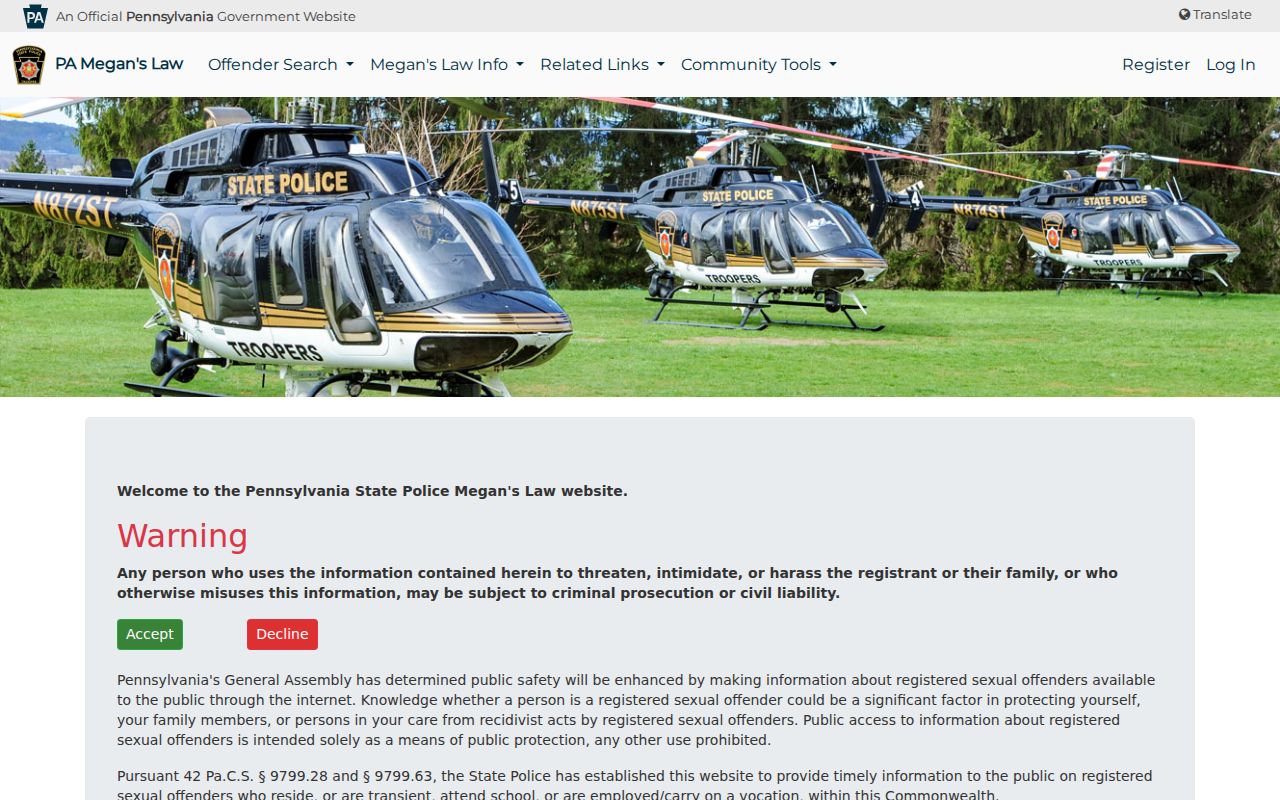
That first screen separates general geographic searches from classification-based lists, helping a reader select a tool before reviewing any profile.
Lycoming County Registry Search Choices
Place searches and name searches answer different questions. County mode is useful for a broad review, but it can return locations far from the area that matters to a user. Municipality or city mode is more focused. ZIP boundaries can cross local lines, so a ZIP result should not be treated as the same thing as a municipal result. The radius tool is the most direct choice for awareness near a home, school, park, or other designated point.
Name matching calls for extra care. Similar names, old addresses, spelling differences, and stale data can cause a mistaken conclusion. PSP expressly warns that the site may not be current or comprehensive. Only a fingerprint comparison provides positive identification. Review the full profile and its photo, physical details, locations, and identifying marks rather than relying on one text field.
Pennsylvania State Police Megan's Law Website Searches
The Pennsylvania State Police Megan's Law Section runs the statewide database. Searchers do not need a county account, but they must pass through the terms page. The most useful sequence is simple:
- Open the official registry and read and accept its conditions of use.
- Select County and choose Lycoming, or use city, municipality, ZIP, radius, name, or a special-status search.
- Compare the result list with known details, without treating a name alone as identification.
- Open the complete profile and review status, locations, offense facts, and other displayed fields.
The controls below reflect the actual routes documented by PSP. No single field is required across every mode because the selected mode determines the input.
| Search or Control | Input | Required | Use |
|---|---|---|---|
| County | County dropdown | For county mode | Select Lycoming for countywide results. |
| Municipality or City | Geographic selectors | For local mode | Narrows results to the selected local area. |
| ZIP Code | ZIP input | For ZIP mode | Returns entries associated with that postal area. |
| Mile Radius | Address and radius | For radius mode | Centers a proximity search on a designated address. |
| Name | Name fields | For name mode | Finds possible matches that still require careful review. |
| Special Status | Status links | No | Opens non-compliant, SVP/SVDC, or transient lists. |
Note: A blank result does not prove that no registrant is connected to the place or person searched.
Lycoming County Registry Verification Sites
Lycoming County has two PSP-approved places for registration verification. Lycoming County Central Processing is at 2651 Euclid Avenue, Duboistown, PA 17702, and its published number is 570-322-6132. State Police Montoursville is at 899 Cherry Street, Montoursville, PA 17754, with the published number 570-368-5700. These are reporting sites for people with registration duties, not substitute public search counters.
PSP advises callers to confirm access and the presence of registering staff before traveling. A registrant should also proofread the finished form before leaving. Many information changes must be reported in person within three business days. International travel requires notice 21 days in advance. Those time rules make a current approved-site check more reliable than assuming an office is always available.
The official Lycoming County verification-site results identify both approved locations and their contact numbers.
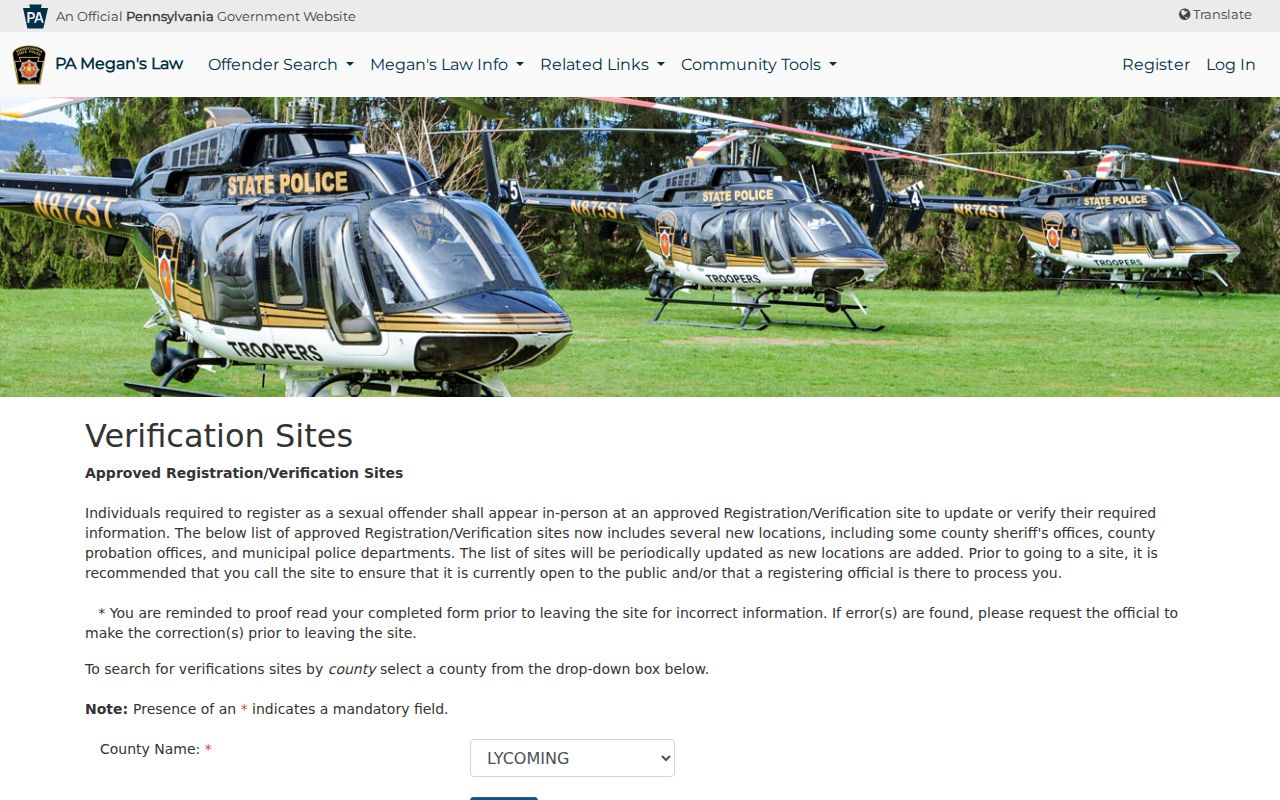
The state listing is the best source to recheck before a visit because registration access and staffing can change.
Registry Profiles: What They Show
A public profile combines identity, classification, compliance, location, and offense information that Pennsylvania law authorizes for display. PSP collects more data than every public page necessarily shows. The public record may include a photo, aliases, physical details, residence or transient information, and work or school locations where authorized. It may also show conviction facts, vehicle data, and scars, marks, or tattoos.
| Name and Aliases | Published names and alternate names used to help distinguish possible matches. |
|---|---|
| Photo and Description | A photograph plus physical traits and, when displayed, scars, marks, or tattoos. |
| Listed Locations | Residence or transient status and authorized work or school locations. |
| Offense Information | Public conviction and offense details tied to the registration duty. |
| Classification | The tier, legacy category, SVP/SVDC status, or other displayed classification. |
| Compliance | Whether the record is shown as compliant or non-compliant at publication. |
| Vehicles | Vehicle information when Pennsylvania law authorizes public display. |
A tier describes registration duration and duties. It is not a score of danger to a neighborhood. Profile data can also age between a change and its publication. Use the listed details for awareness, then contact PSP about a suspected error instead of confronting a person.
Lycoming County Registry Alerts
Repeated manual searches are not the only way to track an area. The registry's official FAQ explains email alerts for a user-selected radius of up to five miles. Notices can cover a registrant's move and changes to work or school information. An alert is tied to the chosen area, so it complements rather than replaces a countywide search.
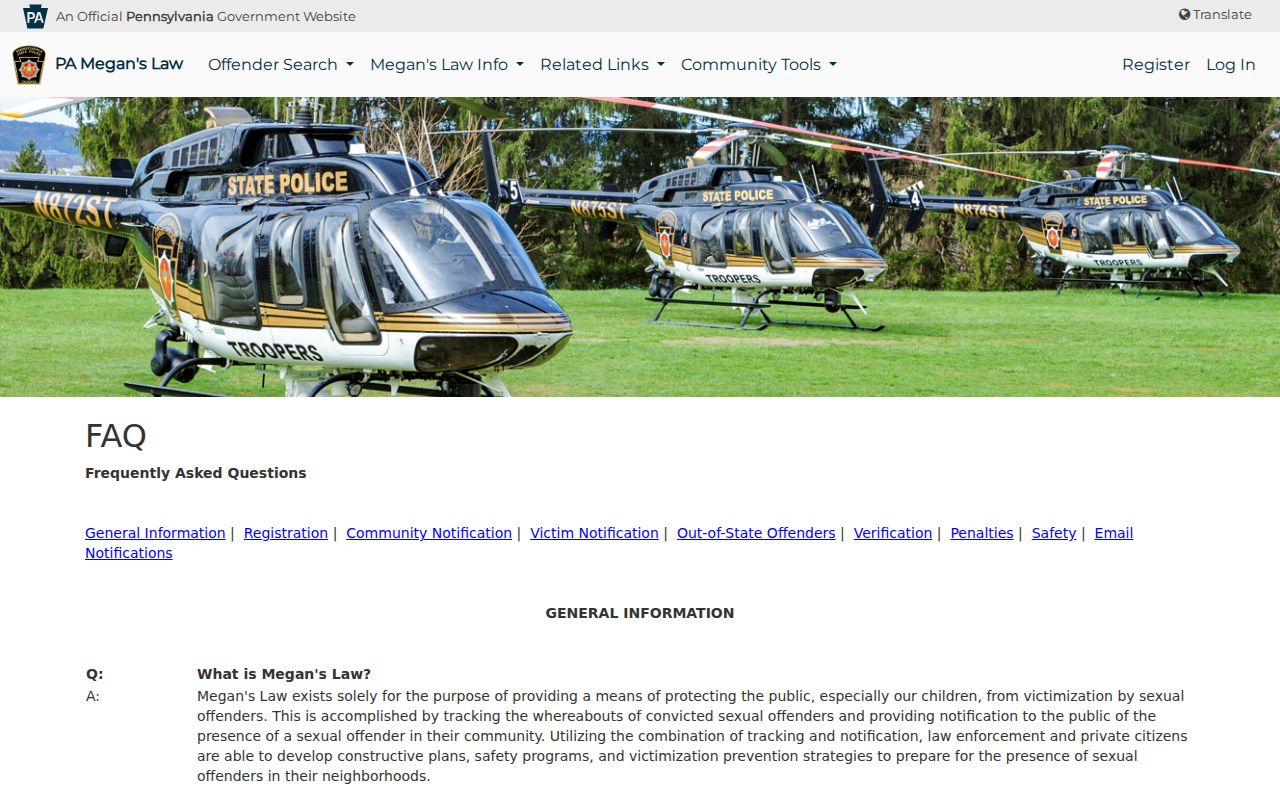
The FAQ view connects proximity alerts to the same state data used by the public registry and explains what types of changes can prompt notice.
Set a radius that matches the place of concern. A five-mile maximum does not mean five miles is always the best choice. A smaller area may produce more focused notices in a dense part of Williamsport, while a wider radius may fit a rural address. Each alert remains subject to the registry's update limits and identification warning.
Registration Levels and Duties in Pennsylvania
Pennsylvania's post-December 20, 2012 tiers operate beside legacy ten-year and lifetime categories. General juvenile registration ended after In re J.B., while a court-classified sexually violent delinquent child remains an exception. Verification frequency changes with classification and transient status.
| Classification | Duration | Verification |
|---|---|---|
| Tier I | 15 years | Annual |
| Tier II | 25 years | Semiannual |
| Tier III | Life | Quarterly |
| Legacy category | 10 years or life | Annual |
| Transient registrant | Applicable period | Monthly |
| SVDC or SVP | Life | Quarterly |
Eligible Tier II and Tier III registrants with three compliant years may complete some nonannual verifications by phone at 1-855-791-1990. The annual in-person appearance still applies. The call must occur within three business days and cannot be used to change information.
The PSP registration information page sets out the current classifications, durations, and reporting rules.
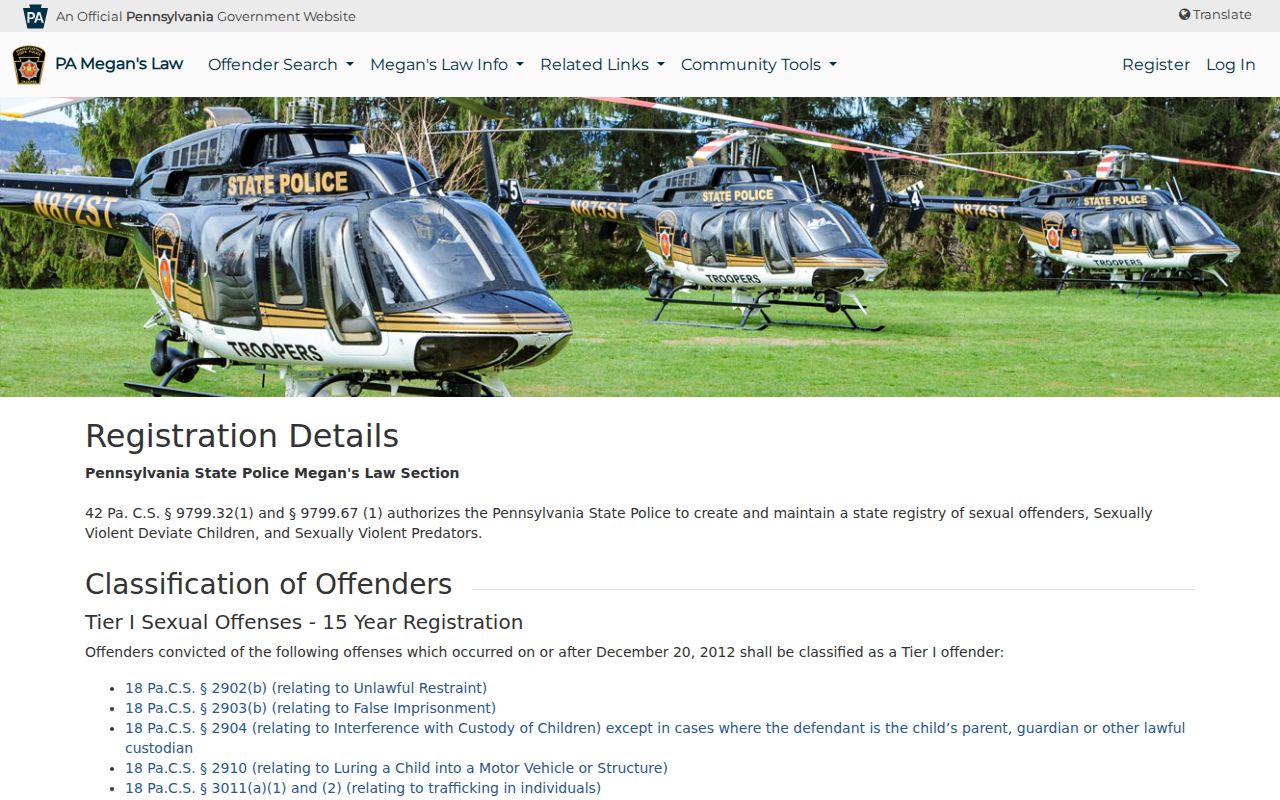
This official overview helps separate a public profile's tier label from the schedule a registrant must follow.
Lycoming County Registry Across State Lines
A Pennsylvania-only search can miss a record maintained by another jurisdiction. The National Sex Offender Public Website, or NSOPW, supplies a cross-state search layer. It draws from participating public registries and is useful when a name or location question reaches beyond Pennsylvania. The PSP site remains the more detailed source for Pennsylvania registration rules and Lycoming County verification locations.
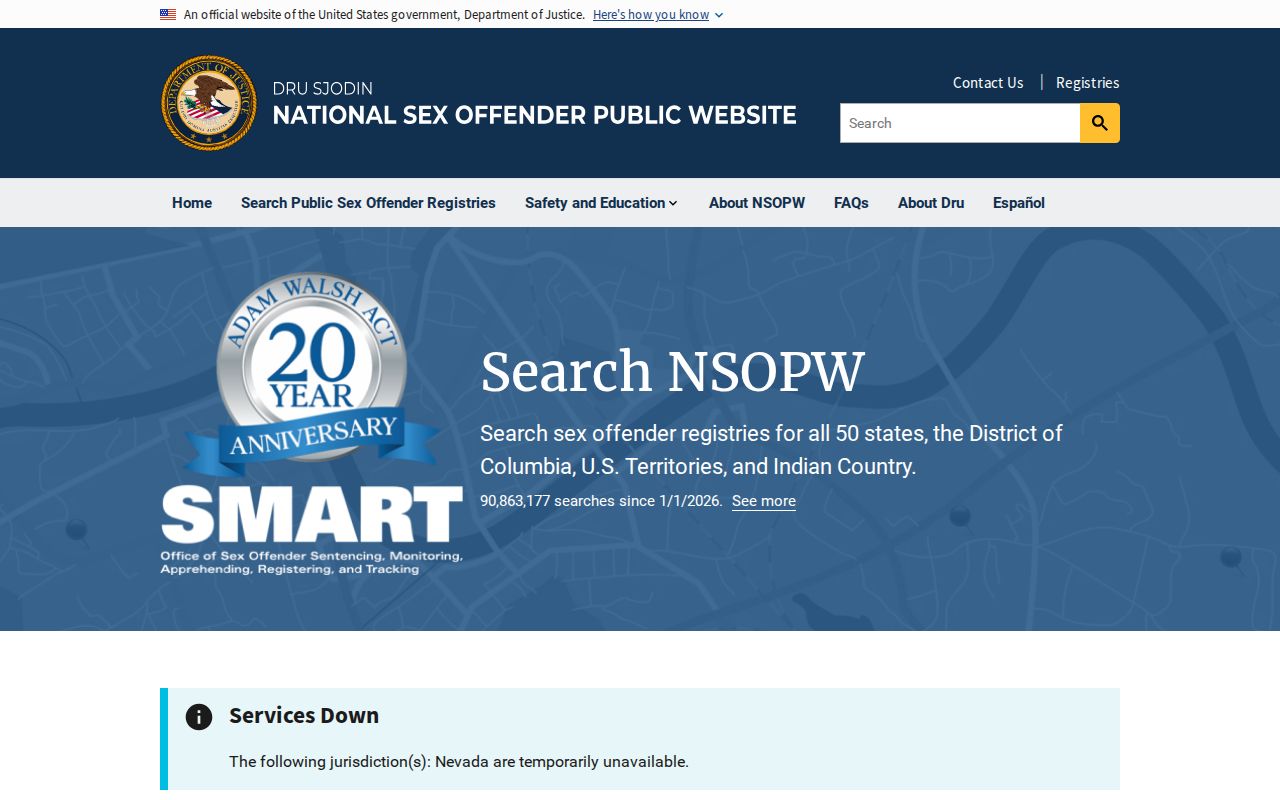
The national interface broadens the geographic scope, but it does not remove the need to read the source jurisdiction's profile and cautions.
Use both systems when a person may have moved across state lines. Start with PSP for a Lycoming County address or Pennsylvania classification. Add NSOPW for a wider search. Then compare full profiles rather than merging similar names into one identity.
Correcting Lycoming County Registry Errors
Registry information may be delayed, incomplete, or wrong. PSP publishes 1-866-771-3170 for suspected errors. Give the agency enough detail to locate the profile and explain the field in question. Do not use the correction route to debate the underlying judgment or classification in public; it is the practical channel for a possible data problem on the website.
A missing listing also has limits. The database is not comprehensive, and a no-result search does not certify that a person has no registration history. Recheck the search mode, spelling, location, and special-status lists. For a cross-state question, repeat the search through NSOPW. For identity, the state's own warning remains controlling: only fingerprints provide positive identification.
Using Registry Information Lawfully
Pennsylvania publishes registry data to support public protection. Sound use means learning about a location, discussing safety plans with family, choosing appropriate alert settings, and giving suspected errors to PSP. It does not mean confronting a listed person or household. A profile reflects the state's public extract and can be stale. It should not be stretched into claims the page does not make.
Authority for public access includes 42 Pa.C.S. § 9799.32(1) and related Pennsylvania registration provisions, including §§ 9799.28, 9799.63, and 9799.67(1). Those rules define authorized publication and reinforce the public-safety purpose.
Misuse can bring legal consequences: Pennsylvania State Police warns that threatening, intimidating, harassing, or otherwise misusing registry information can lead to criminal prosecution or civil liability under the Megan's Law framework, including 42 Pa.C.S. § 9799.28.
Report a data concern through the PSP correction line. If there is an immediate threat, contact emergency services. Community awareness works best when official data is checked with care, identities are not assumed from names, and every person is treated lawfully.